
Istria from Rijeka: Truffles, Wine and Hilltop Towns

Istria is the largest Croatian peninsula, but its charm goes far beyond the Adriatic coast. Unlike many Mediterranean destinations, Istria has an equally fascinating interior – rolling green hills, vineyards, olive groves, forests and medieval hilltop towns overlooking the valleys below.
If you are staying in Rijeka, the interior of Istria makes a wonderful day trip. In less than an hour by car, you can leave the city behind and find yourself among vineyards, truffle forests and stone towns that seem to belong to another era.
Istria has a fascinating history shaped by centuries of Venetian, Austrian and Italian influence. That heritage can still be seen in the architecture, cuisine and languages of the region. Croatian and Italian are both officially used in parts of Istria, while the local cuisine combines Mediterranean, Venetian and Central European influences.
And if you want to experience a particularly memorable side of Istria, the combination is simple: truffles, wine, olive oil and hilltop towns.
Motovun – The Symbol of Inland Istria

Motovun is one of the most famous medieval hilltop towns in Istria.
Standing about 277 metres above the Mirna River valley, the town is surrounded by historic walls and offers one of the most impressive views across the Istrian interior.
Walking through its stone streets feels like stepping back several centuries. The medieval walls are particularly impressive, with views over vineyards, forests and the Mirna valley.
Motovun is also famous for its film festival, which became one of the best-known cultural events in Istria.
Cars are kept outside the historic centre, so the final part of your visit is on foot – exactly as it should be in a medieval hilltop town.
Truffles – The Culinary Treasure of the Motovun Forest

If there is one ingredient that is particularly associated with inland Istria, it is the truffle.
The Motovun Forest and the Mirna River valley are among Europe's best-known truffle areas, including the highly prized white truffle.
The white truffle season is especially interesting from autumn into early winter, while different varieties of black truffles can be found during much of the year.
Istria is also associated with a remarkable truffle record. In 1999, a white truffle weighing 1.31 kilograms was discovered in the Istrian forests and entered the Guinness World Records.
The best way to experience truffles is, of course, at the table – served with fuži or pljukanci pasta, eggs, cheese or other traditional Istrian dishes.
For a more memorable experience, join an organised truffle-hunting tour.
Accompanied by a local guide and trained dogs, you can explore the forest and discover just how much knowledge, patience and experience goes into finding this extraordinary ingredient.
Istria on a Plate – Fuži, Pljukanci and Boškarin

Istrian cuisine is quite different from the food traditionally associated with Dalmatia.
While Dalmatian cuisine often focuses on grilled fish and seafood, inland Istria has a stronger tradition of homemade pasta, meat, game, mushrooms, truffles and olive oil.
Try fuži or pljukanci, traditional Istrian pasta often served with truffles, game or rich local sauces.
There is also maneštra, a traditional hearty soup or stew, and boškarin – meat from the indigenous Istrian cattle breed.
And you do not necessarily need a fine-dining restaurant to experience authentic Istrian food. A small local konoba can be the perfect place to discover the region's traditional flavours.
Istrian Wine – Malvazija and Teran

After truffles comes another essential part of Istrian gastronomy: wine.
Two grape varieties are particularly associated with Istria: Malvazija Istarska and Teran.
Malvazija is Istria's best-known white grape variety. It can be fresh and easy-drinking, while the finest examples can also be complex and suitable for ageing.
Teran is an indigenous red variety, known for its freshness, fruit flavours and distinctive character. It pairs particularly well with meat dishes and the richer flavours of inland Istrian cuisine.
Wine roads run through areas such as Buje, Momjan and Vižinada, and visiting a local winery is one of the best ways to discover Istria beyond the main tourist routes.
Olive Oil – Another Reason to Stop Along the Way

Istria is not only about wine and truffles.
Istrian extra virgin olive oil has earned a strong international reputation and is one of the region's most valued local products.
If you come across a local olive mill or family-run producer, it is worth stopping for a tasting and buying directly from the producer.
It is one of those Istrian products that becomes even more memorable when you know where it comes from – the olive groves you have just driven past.
Grožnjan – The Town of Artists

Grožnjan is one of the most charming small towns in inland Istria.
After losing much of its population in the mid-20th century, artists began moving into the old town. Today, Grožnjan is known for its galleries, studios, music events and creative atmosphere.
Stone houses, narrow streets, galleries and views across the Istrian countryside give it a very different character from the larger coastal resorts.
As in Motovun, cars stay outside the historic centre and the old town is best explored on foot.
Oprtalj – Discover Istria at a Slower Pace

If you are looking for an even quieter atmosphere, add Oprtalj to your itinerary.
This small medieval hilltop town offers exactly what many visitors come to inland Istria to find – stone houses, narrow streets, old squares and views across the green countryside.
There is no need for a strict itinerary here.
Sometimes the best Istrian road trip is the one where you stop simply because something along the way catches your eye.
Buzet – A Town Above the Mirna Valley

In northern Istria, Buzet is another town closely connected with the region's truffle tradition.
The old town sits high above the Mirna valley, surrounded by forests and rolling countryside.
Buzet is a great place to combine history, nature and gastronomy, and it can easily be included in a wider route through northern Istria together with Oprtalj and nearby wineries.
Istria Is More Than Rovinj, Poreč and Pula
When people talk about Istria, they often think first of Rovinj, Poreč or Pula.
And they are certainly worth visiting.
Pula is home to its impressive Roman Arena, one of the world's best-preserved Roman amphitheatres. Rovinj is famous for its historic old town and the Church of St. Euphemia, while Poreč is home to the magnificent Euphrasian Basilica and its Byzantine mosaics, a UNESCO World Heritage Site.
But the interior of Istria offers a completely different experience.
Here, there is no need to rush from one attraction to another. Instead, you can spend a day moving slowly between vineyards, forests, small medieval towns and traditional restaurants.
When Is the Best Time to Visit Istria?
Istria is worth visiting throughout the year, but some seasons are particularly enjoyable.
May and June are excellent for walking, cycling and exploring the hilltop towns before the busiest part of the summer.
July and August bring the liveliest atmosphere, festivals and long evenings, although the coastal towns are also at their busiest.
September and October are particularly appealing to food and wine lovers. The grape harvest, pleasant temperatures and the beginning of the main truffle season make autumn a wonderful time to explore inland Istria.
And if white truffles are your main reason for visiting, autumn is the season to watch.
Istria from Rijeka – A Perfect Day Trip
One of the great advantages of staying in Rijeka is its location between the Kvarner region and Istria.
If you are planning an Istria day trip from Rijeka, travelling by car is the most practical way to explore the interior. Public transport connects the larger coastal towns, but having a car gives you much more freedom to reach the smaller hilltop towns and rural areas.
For a day trip, do not try to see the whole peninsula.
Choose one area and give yourself enough time to enjoy it.
Route 1: Motovun and Grožnjan
Rijeka → Motovun → truffle lunch → winery → Grožnjan → Rijeka
Route 2: Buzet and Northern Istria
Rijeka → Buzet → Oprtalj → local konoba → winery → Rijeka
This leaves enough time for coffee, photographs, lunch and the spontaneous stops that often become the most memorable part of a road trip.
Where to Stay When Exploring Istria?
Rijeka is an excellent base if you want to combine exploring Istria with a stay on the Kvarner coast.
After a day among vineyards, truffles and medieval hilltop towns, you can return to Rijeka, walk along Korzo and finish the evening by the Adriatic.
At Rijeka Apartments Terra, you can choose between several locations depending on the kind of trip you are planning. For guests who want to stay in the heart of the city, Apartment Terra I and Studio Terra II are located in Rijeka Old Town, just steps from Korzo, restaurants and the waterfront.
For a quieter stay closer to nature, Terra Magica Deluxe and Terra Magica Room are located in the Grobnik hills, offering panoramic views of Kvarner Bay and easy access to Rijeka, Opatija and the Grobnik region.
Another option is Terra 5 Deluxe in Viškovo, a peaceful and convenient base with free parking and easy connections to Rijeka, Opatija and the wider Kvarner region.
Choose Your Terra Accommodation
Terra I – apartment in Rijeka Old Town for up to 4 guests
Terra II – modern studio apartment in Rijeka Old Town for 2 guests
Terra Magica Deluxe – spacious apartment in Grobnik with panoramic Kvarner views
Terra Magica Room – comfortable room in Grobnik with private balcony and sea views
Terra 5 Deluxe – peaceful apartment in Viškovo with free parking
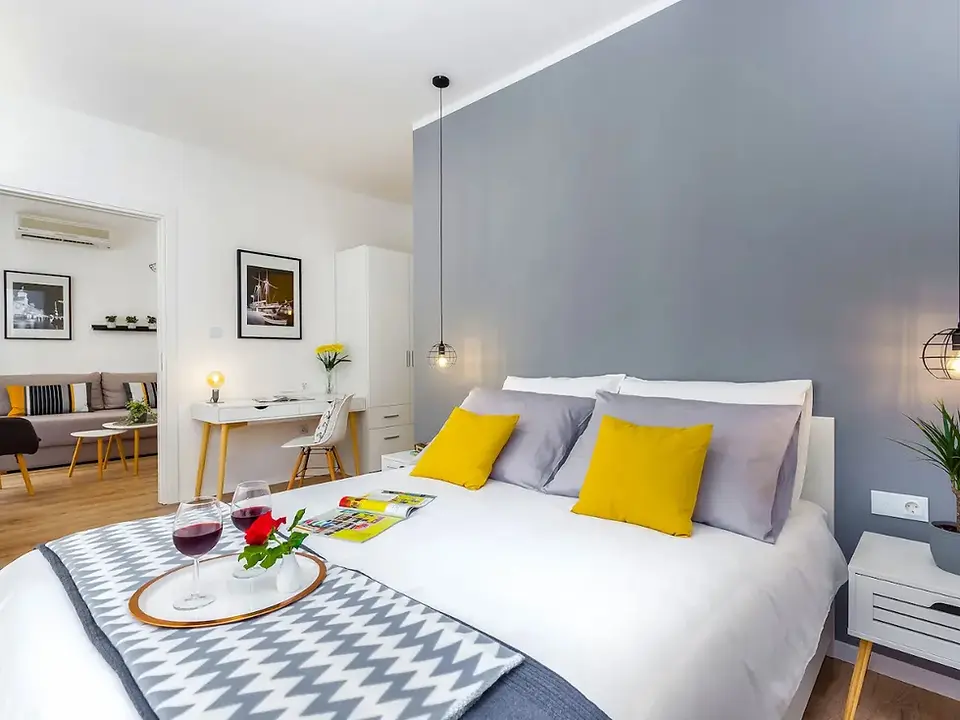
Terra I apartment in Rijeka Old Town 
Terra II studio apartment in Rijeka Old Town 
Terra Magica Deluxe apartment in Grobnik 
Terra Magica Room in Grobnik 
Terra 5 Deluxe apartment in Viškovo
You can check availability and book directly with Rijeka Apartments Terra to choose the accommodation that best fits your trip. Direct booking offers secure payment, instant confirmation and the best available rates.
Discover the Istria That Is Best Enjoyed Slowly
Istria is not a destination to simply tick off a list.
Some of its most memorable moments happen between the main attractions – in a small winery beside a country road, in the aroma of freshly prepared truffles, over a glass of Malvazija, on a quiet stone street in Grožnjan or from the walls of Motovun overlooking the Mirna valley.

If you are staying in Rijeka, Istria is close enough for a day trip, yet special enough to make you want to return.
Truffles, wine, olive oil and hilltop towns – this is the Istria worth taking your time to discover.


